
The Encoding
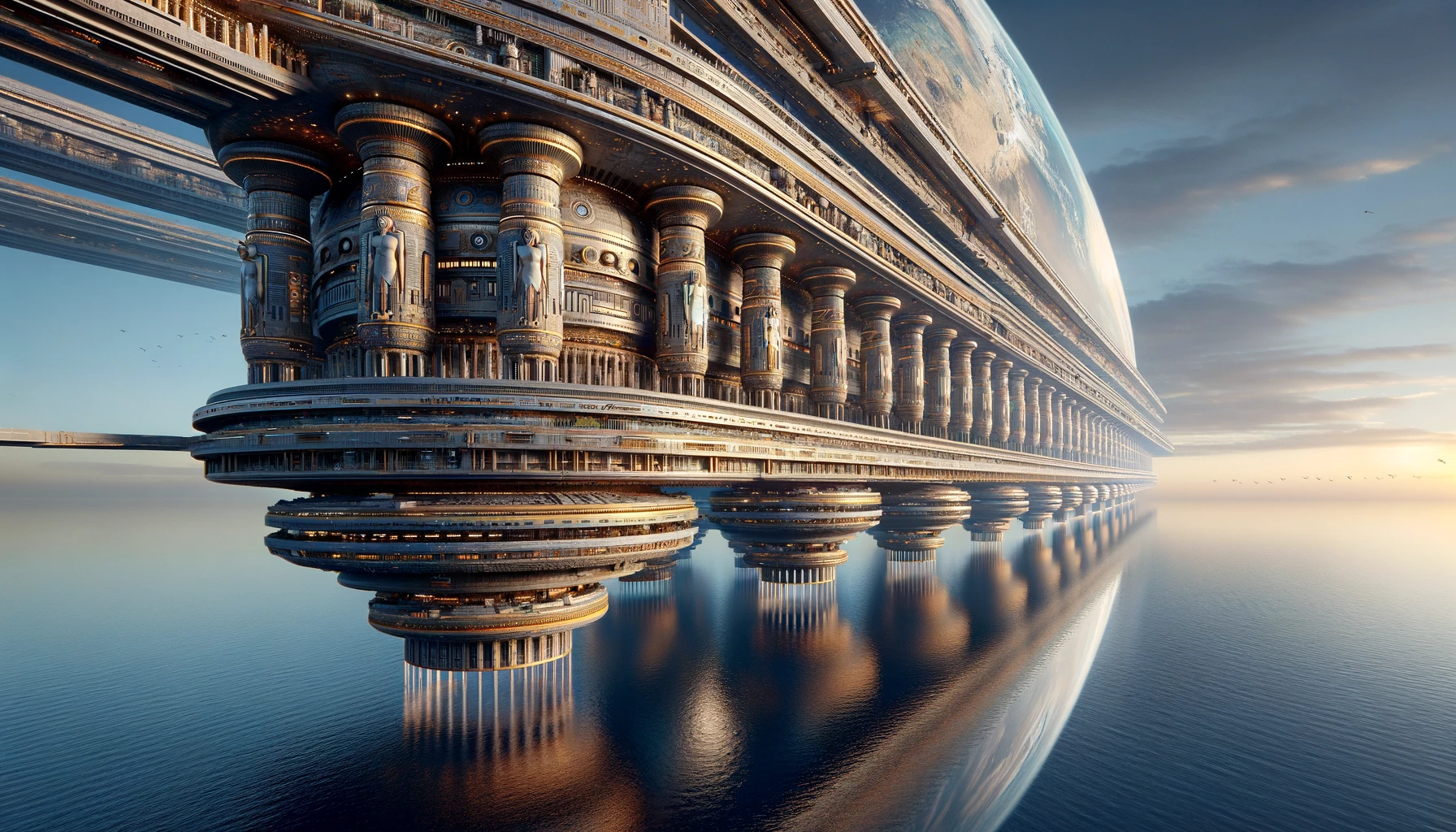
“Last Horus Qa’a, we believe a solution is at hand,” rasped Imhotep.
A sigh of either resignation or relief from Qa’a and then, “We have time, but now would be a fine moment for a solution. For so long, our efforts have been about survival, this last one, if you have found a solution,” he paused, “our rebirth.”
The two walked in the Great Hall of Ra, which encircled the equator of Geb. Built over millennia, the structure rested on bedrock in some places, floated in others, and was suspended on magnetic levitation footings in many others. It was started by Qa’a’s ancestors to celebrate the unification of the tribes of Geb. In the Great Hall, all are welcomed, and no Gebbian is denied entry or movement.
Qa’a reflected. He was the one who demanded the addition of Last to his honorific. His decision was not in defeat but in recognition of the truly existential threat to Geb. Many others then followed suit, adding Last to their family and tribe names. He mused that it really wasn’t necessary, as living on Geb at that moment meant everyone knew you, and they were certainly the last. For Qa’a, it meant the last man of the family, Narmer. Last of the rulers of Geb. Last lover of Neith.
Imhotep floated alongside his beloved Prefect. Old beyond any body, the Great Engineer of the Encoding was mostly augmented except for the core of his brain. Over the years, Imhotep had modified his body to do the practical things he desired. The brain commanded everything from octopus arms to owl eyes and maglift locomotion. That same amazing brain had taken on the challenges of The Save and The Recovery. One had mostly failed, and one, so far, had not.
As they moved, Imhotep once again grieved in the memory of losing Amun. Sekhmet appeared seemingly out of nowhere. The rogue, stellar-mass black hole was on the perfect trajectory to eject Geb’s star Amun and capture planet Geb in its gravity well. When they first discovered Sekhmet, it did not take the royal astronomers long to discover that Amun would be ejected.
Most people remember the light of Amun falling on their home planet. Some, born under Sekhmet, know nothing but the filtered light from the Array. Today, the Array transforms the leaking radiation of photons from Sekhmet to bathe the planet Geb with visibility yet strikingly different light from what they remember from Amun.
Qa’a withheld all of the worst details from his people until he could give them something to cling to, some hope. All of the people of Geb were notified that the black hole Sekhmet would eject Amun, and they were told of the plan for The Save.
The Save was the finale of a series of attempts to keep Geb in orbit around Amun as it was ejected by Sekhmet. The energy needed was so great Imhotep despaired many times. Finally, he came up with the Array. As he and Qa’a moved, he looked up to see the rapidly fading Amun, knowing that the increasing distance would make Amun invisible to the unaided eye in just a few decades. The purpose of the Array was to provide Geb with the energy needed to maintain its orbit around Amun as it was ejected from the local cluster.
After years of construction and innumerable calculations, Imhotep realized that no array could keep Geb with Amun. The solution required too much power. The Array could produce the energy, however, to protect and keep Geb in a thousand-year decaying orbit around the despised Sekhmet. The Save was both failure and success, but ultimately led to the Recovery and now, the Encoding.
If it were not for the Recovery, Geb would be rubble slowly winding into the maw of Sekhmet. The Array was the great invention of Imhotep’s people. It saved the planet from annihilation. As the dark interloper Sekhmet drew near, Imhotep used the Array to provide the delta in Geb’s velocity to almost match the evil black hole’s orbital requirements. With their orbit stabilized, the Array was repurposed to convert Sekhmet’s X-rays into all manner of energies for Geb. Millions upon millions of Gebbians died during the Save and Recovery. Now; however, saving all of Geb was out of the question. What they needed was a plan for the rebirth of their civilization. They called it the Encoding.
“Imhotep,” asked Prefect Qa’a, “What is the current rigor of testing for the solution.” “We are in the 314th iteration of the simulation, my Great Horus,” stated Imhotep crisply. “The last 100 iterations have used some new concepts I would like to discuss now. There is great care to ensure that the Encoding explores our question, can we be rescued from the back hole event horizon, while at the same time, at some point, the Encoding understands its purpose. We seek a bias to ensure that upon understanding its purpose, the Encoding iteration still explores our question. This simple but profound problem is what has stymied us until now.”
Qa’a sighed that double-meaning sound again and repeated in his words what the old Engineer of the Encoding ran through his mind every second of every day, “Our encoding must be robust enough to simulate our universe, with all of the rules that we understand today. We simulate our society within a universe that seeks knowledge. And then, just imagine, a society learns that all they are is a simulation instantiated by a dying people to rescue themselves from a black hole. Why would they continue their discovery, their science? What tool can we insert into the Encoding final iteration to bias the understanding fork to continue the discovery path?”
#
Mark was in trouble. His last research paper had sent Professor Tegmax into one of his spittle rants. As a poor footballer in his youth, Mark had watched a small bit of spittle slowly freeze on his coach’s nose during a similar rant. Now, as Professor Tegmax emphasized the truism of science not being funny, fragments of spittle launched from the event horizon of his lips. Less a spray than an ejecta, the bits-o-spit mostly followed the same trajectory toward Mark with some wildly arcing off in the direction of the great window, spittle attractor.
Mark was not listening. His mind wandered to the last paper he wrote that got him into similar trouble. He was still an undergraduate. The creative writing assignment was one of metamorphosis. Kafka had been consumed, and now it was Mark’s turn to write a classic. The professor probably never anticipated the metamorphosis of food into feces, let alone Kafka, but the line including “individual feces pieces” was a hit in class. The professor required not just a rewrite but a complete do-over.
“Mark, Mark, MARK, you are jeopardizing your credibility, not to mention your career,” moistly aired Professor Tegmax. “I was willing to support your research into mathematics as reality, but this ludicrous human communication is Einstein’s observer is just, well, stupid. Occam would scream. Reality arises from communication. Information has mass. Piffle and gibberish are not research techniques!”
“Sir, Kaufman, Strogatz, and Lareto’s work in the adjacent possible was the key,” Mark declared with the confidence gained from always being some type of rebel. “They showed how true innovation was equal to personal discovery. The mathematics of a person discovering a new song was equivalent to Curie’s discovery of radiation. If it appears increasingly likely that there is another external physical reality, then how does our reality present itself? How do we discover reality?”
“But Mark, communication is what locks in reality? Please, sir,” stewed the Professor.
Interrupting and moving confidently forward with his thesis, Mark declared, “Whatever is in my head, not communicated, is real only to me. As I hold on to some random thought, you and the rest of our reality will react as I either communicate or do not. When I elect to communicate, my words modify all adjacent realities. Some of those language constructs continue to propagate and become a new reality. We are individual observers who, as a collective, communicate the state of reality for our agreed-upon universe. We are the building blocks of reality, and communication is what locks us in our discovery of reality. At one time, the bulk of humanity considered the Sun a god, the world flat, and flight impossible. Once people are able to describe a new reality that permanently modifies enough adjacent realities, then the new reality is resolved. Communication is reality. And let’s not forget, we now know that language, communication, and even music are based on math,” Mark finished strongly.
“Until you come up with a mathematical model that explains this, I loathe to call it a theory, OK theory, then your ideas, to use the German; es ist nicht einmal falsch,” screamed Professor Tegmax.
The Professor’s use of German caused a huge increase in spittle. “That is why I am here, Professor Tegmax, I would like the university to fund my research. Pikovski just found pixelation. Our entire reality is encoded in the event horizon of some black hole. Why do we live on a black hole? Why is communication the discovery tool for reality? You must support my research, Professor,” pleaded a slightly less confident Mark.
With ultimate control and great disdain, the Professor declared, “Get out, you and your crackpot ideas. Pixelation, indeed. Until the entire scientific community can understand, agree, and formulate a testable theory with Pikovski’s research, pixelation and the Holographic principle are not reality!”
“That Professor, I completely agree with,” Mark murmured as he left Professor Tegmax’s office for the last time. Off he went to find answers.
#
“So Imhotep, what is different with this iteration of the Encoding?
“Perfect, we placed the simulation in our future, not our present or past. I did, though, add much of our history into the iteration,” passionately stated Imhotep. “The encoding of this new simulation is holographic, and the learning method is our language. This simulation is intended to tell us what it is like living on an event horizon. Its goal is to ascertain if there is a way to leave the prison of the event horizon. Can our frozen reality leak away from Sekhmet? In the 314th iteration, the simulation has just discovered the holographic reality. Even though the simulation actors have discovered that their universe is trapped on the outer edge of a black hole, it appears that it is continuing discovery. The simulation’s science continues!”
“What was your bias, my wonderful Imhotep?” Last Horus Qa’a asked. What did you do this time to keep the Encoding alive and moving forward?”
“Qa’a, we encoded a bias for hope,” twinkled Imhotep.
“Ah, my dear Imhotep,” smiled Qa’a, “You give hope back to me on this day. The Array gives us light and saves our world from being torn apart. Yet, it will not save us from the same fate as our simulation. So be it: launch the simulation to the Lagrange point. Someday, may a great civilization discover our simulation still at work looking for or having found a reality for leaving the event horizon. May that knowledge free us from Sekhmet’s prison.”
End